My mom was a flight attendant. She and my dad used to take my brother and I on a lot of trips. Once, when I was young, we got on a flight to Germany out of JFK (TWA). Almost immediately after takeoff (presumably from a bird strike), an engine caught on fire. A few things I'll never forget: 1) since it was a night flight and the cabin lights were off, the inside of the plane was lit up so intensely by the flames it would have made the creators of a disaster movie envious, 2) many adults around me were screaming, 3) my mom leaned over and said to me in a voice no less calm than if she were telling me what she packed for my school lunch, "Don't worry, the captain will shut off fuel to that engine and turn around and land. But we'll have to go someplace else for our trip." I instantly went from being terrified to totally relaxed, and the next day we went to Disney World.
Panic as a herd response probably affords some group survival benefit, though it's of relatively little individual utility. The idea being that everyone starts acting unpredictably.
When you're being chased by large predators (or a sudden rockfall, tidal wave, fire, etc.), that may be useful.
When you're in a highly technical environment in which the entire group's survival is a unitary phenomenon (everybody's, or overall, survival either does or does not happen), everyone going their own way is precisely the wrong thing to do. That's a relatively new development evolutionarily.
> "Don't worry, the captain will shut off fuel to that engine and turn around and land. But we'll have to go someplace else for our trip"
Compare to "Don't worry, everything will be fine", I found this calms me down better. Because it keeps me occupied on verifying the claim rather than allowing me wonder about what "fine" was actually meat.
But again, we don't actually know why "many adults were screaming" there, maybe they've already figured it out, and they are screaming because they don't want to go someplace else :-D
It would also calm me down because it is quite specific and shows a possible resolution and course of action, instead of a vague 'fine'. What is fine, when will it be fine, how will it be fine?
In general I think it would also help to educate people more about how much abuse a plane likely can stand. For me a plane is too much of a fragile aluminium tube with a ton of explosive fuel and some superheated engines, at a scary high altitude.
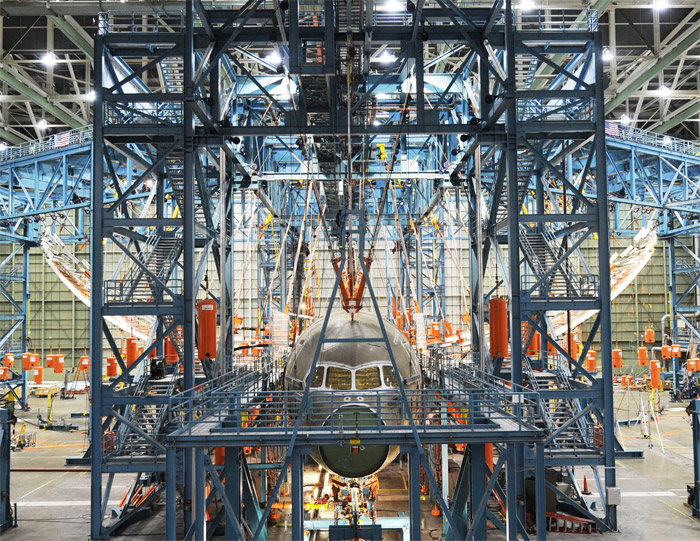
I'm going to educate you more right now - jet fuel is not explosive in the sense that you think it is. It's much less volatile than gasoline and is regularly dumped overboard in emergency situations with no fire risk. Modern jets can fly just fine with one engine shut off like in the OP. Provided that there is enough altitude, planes will glide their way to back a runway to land if both engines go out. The structure can take way more abuse than you think - see this picture of a 787 undergoing a wing structural test. http://blog.flightstory.net/wp-content/uploads/787-ultimate-...
"Hello everyone, this is the captain speaking. This is normally the point where I tell you about the weather in [destination], and that we've reached our cruising altitude. Unfortunately, we haven't reached our cruising altitude, so I won't tell you about the weather.
We have a serious problem with this aircraft, and we're going to return to [origin]. We must first reduce our weight, so those of you at the rear will soon see a white spray from the wings as we dump some fuel. That should take about 20 minutes, and we'll then begin our descent.
Please listen to the instructions from the cabin crew, who will prepare you for the landing."
"Landing", in this case, meant the heaviest landing I've ever experienced, followed by the strongest braking, and fire engines surrounding the plane and spraying the undercarriage. Fortunately, this was a precaution, and we didn't have to evacuate the plane.
The crew stayed with the passengers until everything was sorted out (luggage, hotels etc), and I found myself in conversation with an elderly couple from row 1, the first officer and the purser. The woman passenger said she had seen how calm the purser was, and was reassured that all was fine. The purser replied "ma'am, I'm trained to stay calm. This is the worst incident of my career, and I'm due to retire next year."
The first officer explained that the primary hydraulics had failed. The hydraulic fluid is flammable, and could be leaking somewhere hot (or due to be hot, i.e. the wheels). They pressed a button which opened a valve and flushed the hydraulic pipes with inert gas, but it wasn't possible to know if that removed any/enough remaining fluid -- hence the fire engines spraying the plane when it landed.
I used to fly into a UK gov office for work every week for a couple of years, must have taken over 100 flights so during that time so I got pretty relaxed about flying. Also my mum loves Australia so I’ve been taking long-haul flights to Brisbane from Belfast and back pretty much every year since I was six-years-old.
One time I was taking my usual flight over the Irish Sea and the pilot comes on and says “unfortunately we’ve encountered a mechanical issue and will be redirecting to Manchester”.
That’s the first time I’ve seen people crying on a plane, most people were calm though. I was a bit nervous but I realised there was nothing I could do about it except keep calm and not distract cabin crew.
Never found out what happened, we all just shuffled onto a different plane once we landed at Manchester and then took the shortest flight I’ve ever taken in my life, can’t have been more than 20 minutes from Manc to East Mids


Respect airline crews.