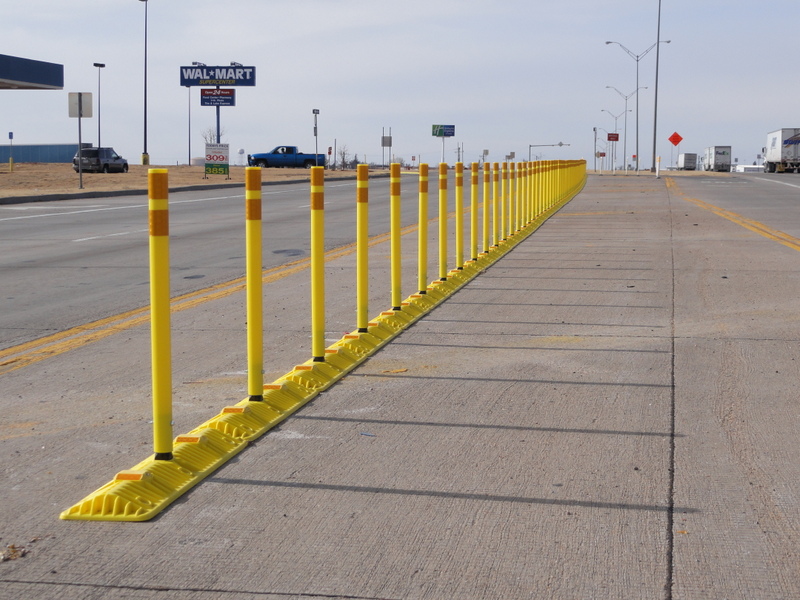
Flexible markers (which aren’t even attempting to be bollards, to be clear) are usually a step up from a simple painted line and often recommended by fire departments and other emergency personnel as they can ignore them with their equipment.
They're often sold as "flexible bollards"[1], so I think it's fair to evaluate them by that title.
I don't object to the idea that EMS or other emergency responders might need roadside access. From my experience, many European cities do this admirably by having retractable bollards embedded in the street, or by redesigning streets to have a bollard-free section (e.g. by the fire hydrant, where it's already illegal to park or idle).
(There's also the irony of not placing bollards into a street crossing because emergency services might need it, when bollards might prevent the need for many emergency responses.)
Back many years ago, we were driving down a two lane highway in a good old Air Force blue Dodge van. Loaded with maybe 8 airmen. Down the center of the road on the yellow line were flexible bollards every couple feet. The area was under construction and the lanes were narrow, and the bollards were to keep drivers alert and in their lane, I guess.
Anyway. Idly chatting with the driver, I asked 'I wonder how sturdy those are, what happens if someone hits them?' A minute or two later, when there was no oncoming traffic, the driver jerked the wheel and put the van in the center of the road. BAM-BAM-BAM-BAM-BAM at 60 mph. Then back in our lane, glances in the rearview mirror, and calmly announces that they go down and stay down.
I nearly crapped myself laughing. What a crazy SOB. Still makes me chuckle at the memory, 30 years later.
There is no point to that story, really, although perhaps that modern flexible bollards like the ones you link to claim to stand back up if they get hit. But do they, if the car is doing 60 mph? Hmmm. Lucky for those bollards, I don't drive a big ugly blue Air Force van. And I'm too much of a rule follower.
Staggering bollards and fake bollards could be an effective cost-saving measure, if for some reason the city finds bollards too expensive to put everywhere. If the drivers know that 10-20% of the bollards are the real deal, they'd steer clear of all of them.
It can be for either. These ones for example are unlikely to stop a truck going at high speed, but will stop someone who doesn't want a repair bill from parking.
Those greatly reduce bad parking, but they also do provide some security from lower-speed collisions; yes it's possible for a truck to hit it fast enough to go through it, but it'll do quite a number to a low speed vehicle, and even if it doesn't completely stop it, greatly reduce the velocity if it does hit someone.
> when bollards might prevent the need for many emergency responses
I doubt that? If a bollard stops a car which would have caused an emergency that is often reason enough for an emergency response in itself. It doesn’t change the number of emergency calls, just changes the form of the emergency.
Also the whole argument you are making is silly. A bollard on a street crossing can prevent some kind of emergencies (the kind a runaway vehicle would cause). It absolutely does nothing to prevent other kind of emergencies (like fires caused by faulty wires, or hearth attacks) but might lenghten the response time for those. There would be maybe some form of irony if emergency responses were only required because of runaway cars, but that is far from the case.
> I doubt that? If a bollard stops a car which would have caused an emergency that is often reason enough for an emergency response in itself. It doesn’t change the number of emergency calls, just changes the form of the emergency.
A somewhat common automotive accident in NYC is one where a driver falls asleep or unconscious at the wheel, causing (or nearly causing) a mass casualty event on a sidewalk. These kinds of tragedies can happen at low speeds, since the car rolls forwards silently over the curb and hits pedestrians or cyclists from behind. Bollards would stop this, just like they would stop cyclists from being backed into by trucks in bike lanes, and pedestrians from being sideswept on non-daylit corners, etc.
Of course, these are contrived examples. But the larger phenomenon holds: a single driver injured after collision with a bollard requires fewer emergency resources than a driver plus pedestrians injured after collision with a building.
I'll point out again: other cities have solutions for this that clearly work without impeding emergency response. Compare London's emergency response times[1] to NYC's[2].
They're somewhere in between a line and a fixed bollard. They are more effective at encouraging drivers to voluntarily stay in their lane than a line is, but they still don't do anything to prevent vehicles from crossing in emergency situations, accidents, or people who don't care about the paint on their car. It would be cost prohibitive to replace this usage with retractable bollards because these often extend for long distances.
> Flexible markers (which aren’t even attempting to be bollards, to be clear) are usually a step up from a simple painted line
There's a T-intersection near my house which is more of a 30°/150° split, and I'm glad they finally upgraded to those not-quite-barriers: It has reduced the number of people who were ignoring the stop-sign and driving straight through as if it were just a curve in the road, which could easily cause head-on collisions. (The gore-point is also paved, not a raised curb.)
Even so, some of the sticks have been lost to attrition now, and I kinda wish they'd get replaced with much heavier ones guaranteed to leave big dents and scratches...