I've hosted my mailserver myself for years now.
I recently (a number of months ago) have started using Mox for my mail server (after using stalwart, manual postfix/dovecot, a couple others). It's a perfect solution for a small personal mailserver.
It's among the simplest (/least complicated) mail servers I've used, and I have to waste basically zero time on it. Running backup & update every couple months takes <5 min.
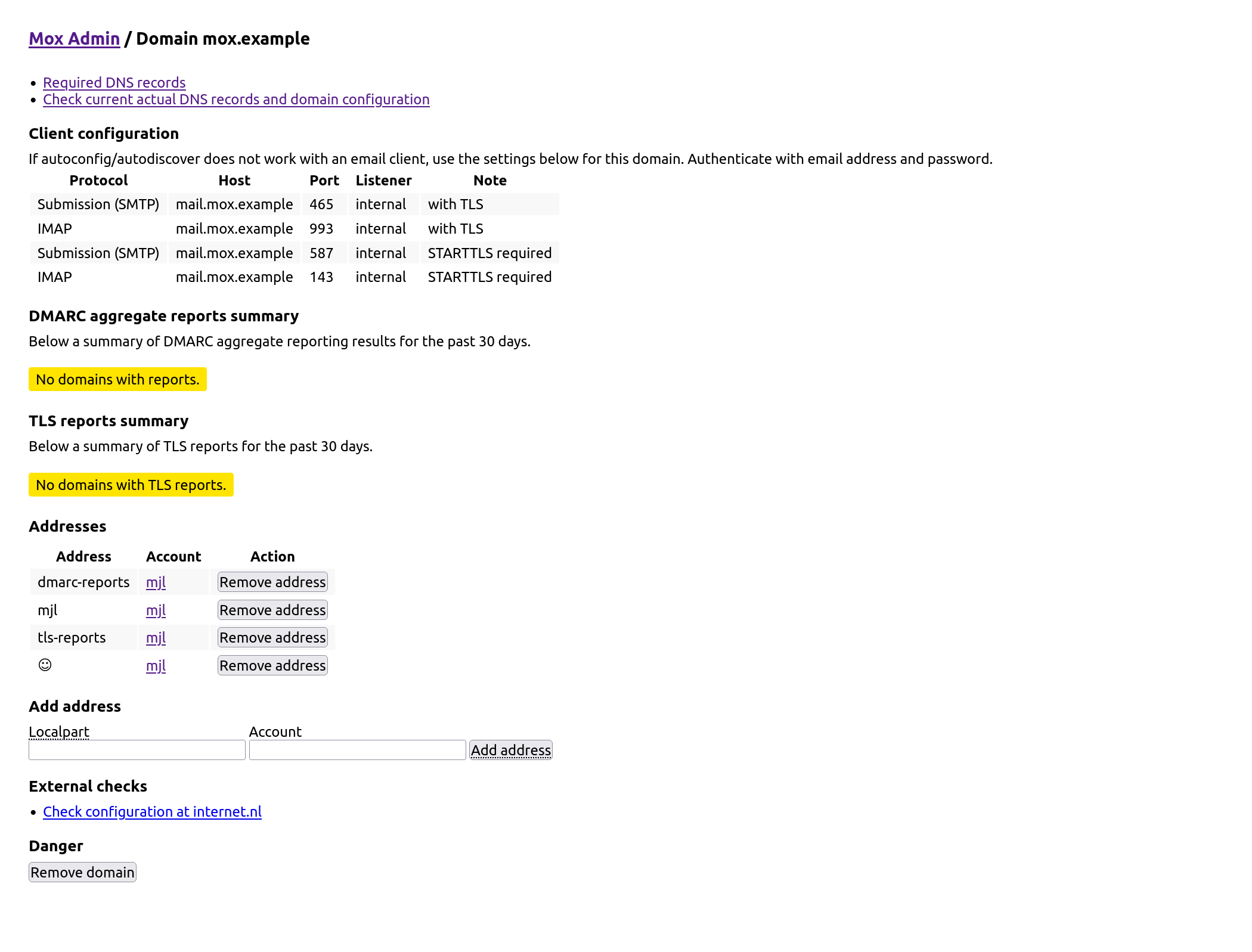
However, I noticed: when I showcase it to some people, some of them mistake the very simple minimalist web interface for being ‘outdated’ or similar - it appears that to be "modern", things are required to be extremely bloated, and even technical people look down on fast (seriously: try it) clutter-less design.
An overstated problem IMO. Even just Thunderbird's client-side filtering works well enough to mostly ignore it and just occasionally go sweep through the spam folder to see if anything was caught inadvertantly. If you run your own server you can also setup whatever spam filter you want but personally I care more about real people being able to contact me than I care about never seing any spam (subjects only, pretty easy to tell what is worth openingn from subject + sender).
> 2. Being considered spam by major mail services (where most of one’s recipients will usually reside)?
Which may or may not be a problem for a personal mail server. Personally I have never had any problem with Gmail (YMMV) which at this point covers pretty much everyone I know who doesn't run their own server. Microsoft doesn't like my server due to others on the same block but so far I have decided that's not my problem.
personally - gmail is extremely plagued by spam. sure it goes into the spam mailbox most of the time, but enough non-spam email goes there too so you still have to check it. the current plague for me is "your package is awaiting delivery" spam - almost daily.
for being considered spam - i've had like 3 irl things set up on my old self-hosted mail, and these 3 arrived, even though while testing shortly after making the setup i did end up in spam. i don't know if companies have a whitelist of "if a user has this email on his account, don't send to spam" or something, but it hasnt been an issue.
i don't usually email too many individuals, in my social circles emails is not for that and has pretty much died long ago.
Due to the decent success i've had, i've spent some time today setting up mox to potentially replace my other solution - it is a bit of a process, many dns entries to make, and DNSSEC in my country seems to only update once a day so i'll see if i can enable it tomorrow, but so far it's working (but as usual, the first test email lands in spam.) i assume delivery will improve as soon as the domain is a bit older - i imagine most big mail services block email from a domain created the same day the mail is sent.
Besides actual spam spam, Gmail also gets more random similar-named people giving your address to service providers if you have something like initial + lastname or similar. There are too many "legit" companies that don't implement e-mail verification and just repeatedly send to whatever was provided.
> I’m honestly curious, what’s the point of a personal mail server nowadays?
There's a large number of cool things possible, my favorite is having a catch-all domain (or multiple). Most of the time when you buy mail hosting from your domain registrar for example, you pay by mailbox. Same goes for the majority of mail hosters in general.
With a catch-all domain, you can email <anything>@example.org, and I will get it. I don't have to first generate some addy.io or simplelogin.io or Firefox Relay alias; I can simply enter <company name>@example.org or <service>@example.org when registering on a website, hell I do that even on physical (paper) forms.
Later on, I can decide to add an alias with special configuration, e.g.: email arrives at <tax department>@example.org? → Route to "High importance" mailbox; I receive a Newsletter from a company I never heard of → <company name>@example.org sold my email address (and they can't strip the marker off, which they easily could with the +suffix).
  > Isn’t it the case that today they have two huge disadvantages:
  > 1. Being plagued by spam,
I do not remember having received a single spam email in the last months. In fact, I just looked up the stats: My personal (non-business, non-work) inbox in Thunderbird reaches back to about 2024-03-14, with about 2500 elements.
My spam folder currently contains 0 elements.
And I don't even have any advanced spam filtering or reputation blacklists or anything similar setup.
> 2. Being considered spam by major mail services (where most of one’s recipients will usually reside)?
I actually tried this out some months ago with an "email placement tester": I can comfortably reach Gmail & Google Workspace, Hotmail/Office 365/Exchange, and a few others that were tested that I forgot about.
I do not remember mails of mine not reaching their intended receiver very often - while this might happen once a year (that you send an email and one second after get a "your message could not be delivered" response), I actually hear about this more often from peers using the largest email provider in the DACH region (GMX), so apparently I rank better? It's usually a misconfiguration from the receiver setting up some scam DNS blocklist (e.g. UCEPROTECT). Wouldn't call this a problem of the mail server though, and as I said, even some rather large (commercial) providers have the same issue.
Generally speaking, if you do things right, email will go well for you - this "doing things right" has simply for a long time been quite hard (when postfix/dovecot was prevalent where you need n-number of different third-party software packages, e.g. OpenDMARC). Nowadays, with the modern mail servers available, like Mox (or Stalwart, or Maddy) doing "things right" is very simple: Choose an hoster/ISP with good IP reputation (e.g. check with https://multirbl.valli.org/ if they are on any blocklists), setup your (modern) mailserver, and you're golden.
And this will come with a nice number of advantages:
- you have your own domain, so you're portable
- you control and are able to customize your email infrastructure (how many mailboxes do I want for my use cases, how would I like different aliases to be mapped to them, catch-all/wildcard, applying scripts on these mailboxes, etc)
- privacy/security: Your email (which I consider deeply core to the modern internet infrastructure and ones digital identity (due to controlling the login to basically all websites)) lives on your infrastructure, and no-one but you can access them
- selfhosting is fun, and one gains lots of knowledge about inner workings of the internet with it
Catch-all domains are supported by GMail[1], and some registrars (example, namecheap [2]) will also forward all emails. Namecheap gives you 100 pre-defined mailboxes that can forward to different outgoing boxes, in addition to a catch-all.
> I receive a Newsletter from a company I never heard of → <company name>@example.org sold my email address (and they can't strip the marker off, which they easily could with the +suffix).
This isn't reliable as true catch-all adresses (i.e. any local part works) are easily detected at which point spammers can just use whatever. I also don't find this too useful because usually you either can't afford to stop doing business with the company (in which case you get to be angry but can't take any real action) or you could have just used a temporary address in the first place.
> However, I noticed: when I showcase it to some people, some of them mistake the very simple minimalist web interface for being ‘outdated’ or similar - it appears that to be "modern", things are required to be extremely bloated, and even technical people look down on fast (seriously: try it) clutter-less design.
The design is ugly. It could easily be made much more beautiful while adding zero clutter.


It's among the simplest (/least complicated) mail servers I've used, and I have to waste basically zero time on it. Running backup & update every couple months takes <5 min.
However, I noticed: when I showcase it to some people, some of them mistake the very simple minimalist web interface for being ‘outdated’ or similar - it appears that to be "modern", things are required to be extremely bloated, and even technical people look down on fast (seriously: try it) clutter-less design.